
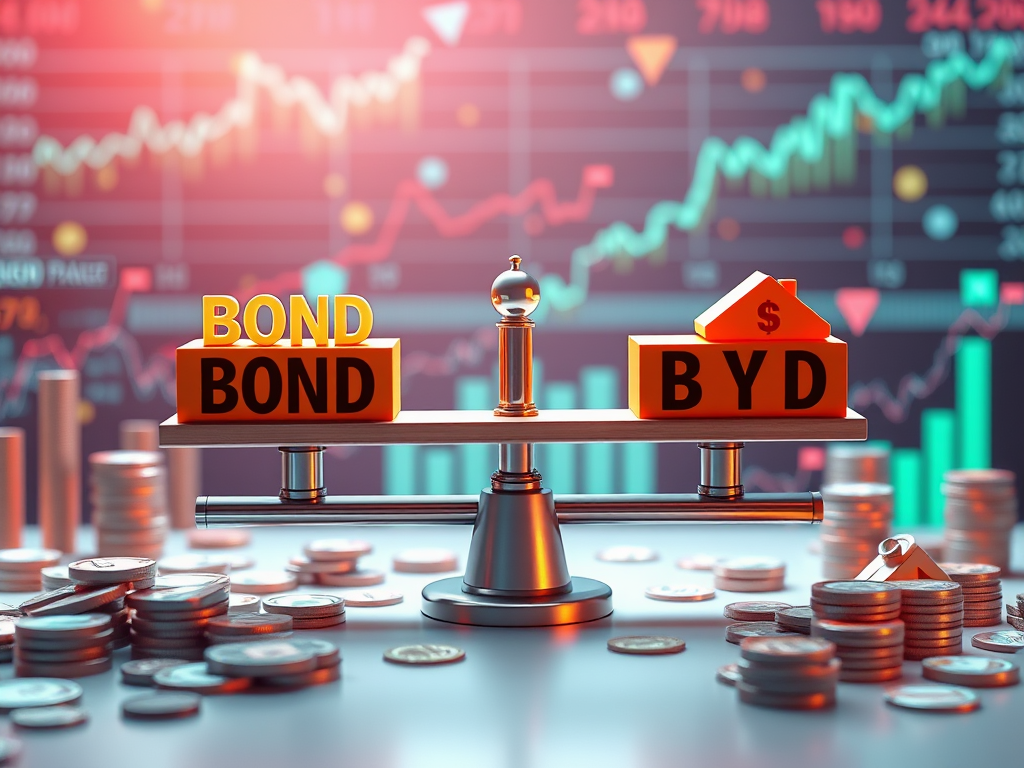
Ever feel like financial news sounds like a secret code? Words like “bond yields” and “market prices” get thrown around, and you’re left nodding along, hoping no one asks you to explain. Well, buckle up, because today we’re cracking that code and making bond talk not just simple, but actually exciting!
Imagine you’re a financial detective. Your mission? To understand one of the most fundamental duos in the investing world: Bond Prices and Bond Yields. And trust me, once you get this, a whole new layer of the financial world will click into place.
What in the World is a Bond, Anyway? Think of it as a Fancy IOU!
Forget dusty textbooks. At its heart, a bond is super straightforward:
- You’re the Lender: When you buy a bond, you’re essentially lending money to an organization (like the government or a big company).
- They Owe You: They promise to pay you back the original amount, called the Face Value (or Par Value – say, $1,000), on a specific future date (the Maturity Date).
- The Sweetener (Coupon Rate): For letting them use your cash, they’ll also pay you regular interest payments. The percentage they pay on that face value is called the Coupon Rate. So, a 5% coupon rate on a $1,000 bond means you get $50 a year. Sweet, right?
Sounds simple so far? Great! Now, let’s get to the juicy part.
Bond Price: The Popularity Contest of IOUs
Just because our imaginary bond has a $1,000 face value doesn’t mean it always sells for $1,000 on the open market. This is where the Bond Price comes in. It’s what investors are actually willing to pay for that bond right now.
Think of it like concert tickets:
- Hot Ticket (Premium): If everyone wants tickets to see Taylor Swift (because she’s amazing, duh!), a $100 ticket (face value) might sell for $300 (a premium!). Our bond is similar. If it’s offering a really juicy coupon rate compared to newer bonds out there, people will pay more than its face value.
- Not-So-Hot Ticket (Discount): If it’s a band no one’s heard of, that $100 ticket might go for $50 (a discount). If our bond’s coupon rate is looking a bit sad compared to what new bonds are offering (maybe interest rates in the wider economy have shot up), its price will likely drop below its face value.
Bond Yield: Your REAL Return on Investment!
Okay, so the coupon rate is fixed. But if you bought the bond for more or less than its face value, your actual percentage return changes. This, my friends, is the Yield!
- Yield is King (or Queen!): It tells you what your investment is truly earning you based on the price you paid.
The Main Event: The Bond Market See-Saw! Prices vs. Yields
Here’s the golden rule, the concept that will make you sound like a financial guru: Bond Prices and Bond Yields move in OPPOSITE directions.
Imagine a see-saw:
- Price Goes UP ↑ … Yield Goes DOWN ↓
- Why? If you pay more for a bond (higher price, say $1,100 for our $1,000 bond that pays $50 interest), that fixed $50 interest payment is now a smaller percentage of your bigger investment. So, your yield drops! ($50 / $1,100 = roughly 4.55% yield, even though the coupon rate is 5%).
- Price Goes DOWN ↓ … Yield Goes UP ↑
- Why? If you snag a bargain and pay less for that same bond (lower price, say $900 for the $1,000 bond paying $50 interest), that fixed $50 interest payment is now a bigger percentage of your smaller investment. Boom! Your yield jumps up! ($50 / $900 = roughly 5.56% yield).
Why the See-Saw? Blame It on Interest Rates!
The biggest reason for this see-saw dance is the overall level of interest rates in the economy, set by folks like the Federal Reserve.
- Interest Rates Rise: If the Fed raises rates, new bonds being issued will likely offer higher coupon payments. Suddenly, older bonds with their lower coupon rates look less appealing. To compete, the price of those older bonds has to fall. And as we know, when price falls, yield goes up for the new buyer, making it an attractive deal again.
- Interest Rates Fall: If the Fed lowers rates, new bonds will offer lower coupon payments. Those trusty older bonds with their higher coupon rates? They suddenly look like superstars! Everyone wants them, so their price goes up. And when price goes up, yield goes down for anyone buying at that new, higher price.
Why Should You Care? Your Investor Superpower!
Understanding this bond price/yield see-saw isn’t just trivia. It’s an investor superpower!
- Smarter Decisions: It helps you understand why your bond investments might be changing in value.
- Economic Barometer: It gives you insight into what the market thinks about the direction of interest rates and the economy’s health. When you hear on the news that “bond yields are rising,” you’ll know that likely means existing bond prices are falling.
- Spotting Opportunities: You can better assess whether a bond is a good buy based on its current price and resulting yield.
You’ve Got This!
So, there you have it! Bond prices and yields, demystified. It’s all about that IOU, what people are willing to pay for it, and how your actual return plays on a see-saw with that price, largely thanks to the ever-changing world of interest rates.
Next time you hear those terms, you won’t just nod along – you’ll know the exciting dance happening behind the scenes. Go forth and conquer the financial news!

Leave a comment